 14174 Trustpilot Reviews
 Free Shipping Over $79



Men's Ring Size Guide: How to Measure Your Ring Size
Getting the right fit for your ice shouldn’t mean taking an unnecessary trip to a jewelry shop. Whether you’re locking down a bold statement piece, stacking your daily drip, or finishing off a streetwear fit, measuring your ring size at home is quick and effortless when you know the right play.
Getting the right fit for your ice shouldn't mean taking an unnecessary trip to a jewelry shop. Whether you’re locking down a bold statement piece, stacking your daily drip, or finishing off a streetwear fit, measuring your ring size at home is quick and effortless when you know the right play.
Finding your ideal fit is simple: US men's ring sizes usually fall between 7 (17.2 mm) and 14 (23 mm), with Size 10 being the most popular choice. Just compare your finger's inner diameter or circumference against our sizing chart to lock in your perfect match.
Quick US & CA Men's Ring Size Chart (Sizes 7–14)
If you already know your finger's measurements in millimeters, use this streamlined chart for quick reference.
US / CA Size | Inside Diameter (mm) | Inside Circumference (mm) |
7 | 17.2 mm | 54 mm |
8 | 18.2 mm | 57.2 mm |
9 | 19.0 mm | 59.7 mm |
10 (Average) | 19.8 mm | 62.2 mm |
11 | 20.6 mm | 64.7 mm |
12 | 21.4 mm | 67.2 mm |
13 | 22.2 mm | 69.7 mm |
14 | 23.0 mm | 72.3 mm |
How to Measure Your Ring Size: 2 Quick At-Home Methods
You don't need fancy tools or a trip to the store to find your ring size. You can get an accurate measurement in under two minutes using items you already have around the house.
Method 1: Borrow an Existing Ring (Best & Easiest)
If you already own a comfortable men's ring that fits your intended finger, this is the quickest and most reliable at-home method.
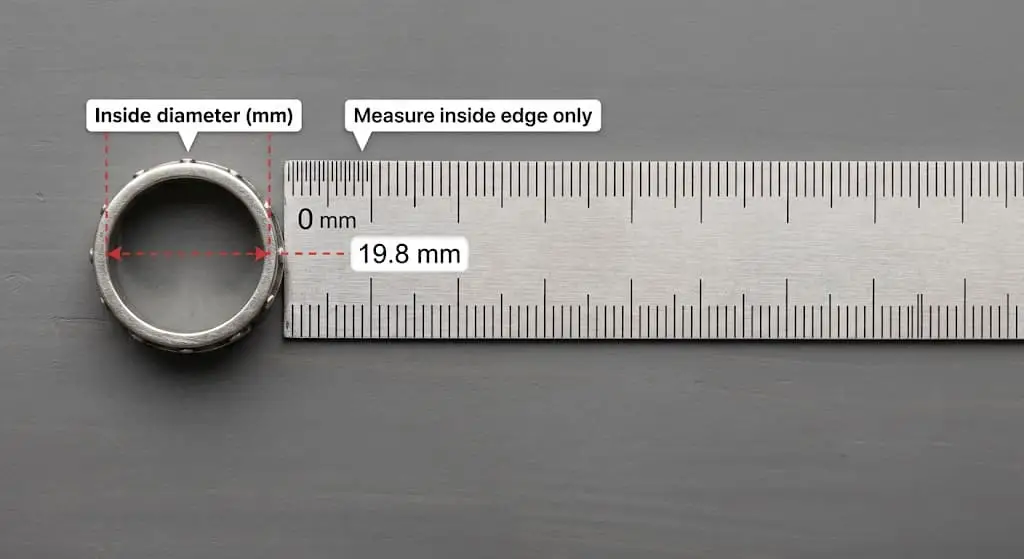
• Tools Needed: A well-fitting ring, a standard ruler (with millimeter markings).
• Step 1: Place the ring flat on a hard, clean surface.
• Step 2: Align the zero mark of your ruler with the inside edge of the ring.
• Step 3: Measure straight across to the opposite inside edge to find the inside diameter in millimeters.
Important Note: Measure only the open space inside the ring. Do NOT include the thickness of the metal walls.
Method 2: Paper Strip / String & Ruler Method (Most Practical)
This technique requires zero specialty equipment—just a couple of everyday household items.
Watch this 33-second video to see how it works:
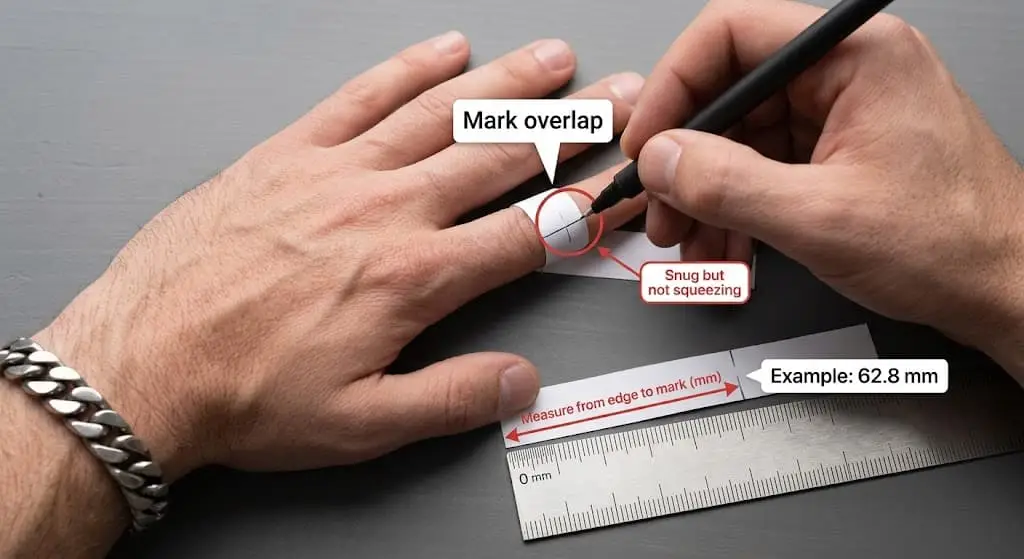
• Tools Needed: A strip of non-stretch paper (approx. 1 cm wide) or a piece of non-stretch string/cord, a pen, a ruler.
• Step 1: Wrap the paper strip or string snugly around the base of your finger.
• Step 2: Ensure the fit is comfortable—tight enough to hold, but not squeezing your skin.
• Step 3: Mark the exact spot where the paper or string overlaps with a fine-point pen.
• Step 4: Lay the paper or string flat against your ruler and measure the length from the starting edge to your mark in millimeters to get your inside circumference.
Pro Tip: If using a string, make sure it is completely non-stretch (such as fishing line or cotton baker's twine). Elastic or flexible strings will stretch during measurement and result in an oversized ring recommendation.
Want 100% Precision? Alternative Pro Options
While the two methods above are fast and easy for most people, here are two alternative options if you prefer maximum accuracy before ordering.
Option A: Physical Ring Sizer Belt
If you happen to own a plastic ring sizer—or pick one up online—it offers a fool-proof way to test how a ring feels sliding over your knuckle.
• Tools Needed: A plastic ring measuring belt or gauge set.
• How it works: Feed the strap through the buckle to form a ring shape, slide it onto your finger, and adjust until snug. Slide it back over your knuckle to ensure it slips off with slight resistance without forcing it.
Option B: Visit a Local Jeweler
If you're near a mall or jewelry shop, you can step in for a quick, hassle-free sizing.
• Tools Used: Professional metal ring mandrels and gauge sets.
• How it works: A jeweler will use weighted metal sizing loops to give you your exact, standard US ring size in seconds.
Important Pro-Tips to Avoid Sizing Errors
• Measure the Exact Finger and Hand: Your dominant hand is almost always slightly larger than your non-dominant hand. Never assume your left ring finger matches your right ring finger.
• Account for Knuckle Size: Men frequently have prominent knuckles. If your knuckle is visibly wider than the base of your finger, measure both locations. Choose a size halfway between the two so the ring clears your knuckle without spinning loosely at the base.
• Factor in Ring Width: Men's bands typically measure between 6 mm and 8 mm wide. Wider bands cover more skin surface area, creating more friction and fitting tighter than slim bands. If you are buying a wide band (6 mm+), size up by half a size.
• Measure at the Right Time: Fingers naturally swell and shrink throughout the day due to temperature, hydration, and activity. Measure your finger in the late afternoon or evening when your hands are warm for the most accurate result. Avoid measuring early in the morning or right after working out.
• Measure 2–3 Times: Always double-check your readings using the same or alternating methods to ensure consistency before placing an order.
• What to Do When Between Sizes: If your measurement falls directly between two sizes, always size up. A slightly loose ring is far more comfortable and easier to adjust than one that cuts off circulation.
Full International Ring Size Conversion Chart
If you are purchasing outside the US/Canada region or converting from a different standard, use this complete sizing table.
US / CA / MX / PR | UK / AU / IE | EU (DE / FR / NL / IT / ES / SE) | Inside Diameter (mm) |
7 | N 1/2 | 54 | 17.3 mm |
8 | P 1/2 | 57 | 18.2 mm |
9 | R 1/2 | 59.5 | 19.0 mm |
10 (Average) | T 1/2 | 62 | 19.8 mm |
11 | V 1/2 | 64.5 | 20.6 mm |
12 | X 1/2 | 67 | 21.4 mm |
13 | Z 1/2 | 69.5 | 22.2 mm |
14 | — | 72 | 23.0 mm |
Regional Sizing Guide:
• US / CA / MX / PR: United States, Canada, Mexico, and Puerto Rico share the same numerical sizes.
• UK / AU / IE: United Kingdom, Australia, and Ireland use standard letter sizes.
• EU Standards: Covers Germany, France, Netherlands, Italy, Spain, Sweden, and most European countries (based on ISO inside circumference in mm).
Frequently Asked Questions (FAQ)
Q: What is the most common men’s ring size?
A: The standard average ring size for men is US Size 10 (equivalent to UK Size T 1/2 or EU Size 62). Standard men’s sizes globally range from US Size 7 to 14.
Q: What should I do if I am between two ring sizes?
A: Always choose the larger size. It is significantly easier to wear a ring that is slightly loose—or add a discreet silicon sizer—than to struggle with a tight band that gets stuck on your knuckle.
Q: Does ring width affect how a ring fits?
A: Yes. Rings with a width of 6 mm or wider cover more surface area on your finger and feel tighter than thinner bands. When ordering a wide-band men's ring, it is best practice to select half a size larger than your measured base size.
Q: How should a properly fitted men's ring feel?
A: A proper fit should slide over your knuckle with light friction, then rest comfortably at the base of your finger without pinching or leaving deep indentations in your skin.